$35.00
Dwarf Hackberry
Celtis tenuifolia
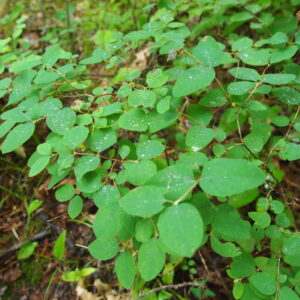
A rare and protected native shrub in Ontario and one of the most unique members of the hackberry family. This small, scraggly shrub has many short, divergent branches that give it a distinctive open form.
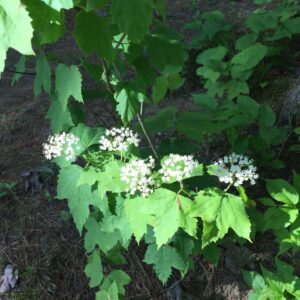
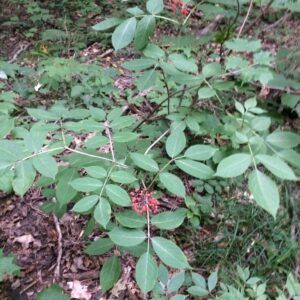
Tiny white flowers appear in late spring and are followed in fall by small orangy-brown berries that are edible and enjoyed by wildlife.
A Rare Species of Ontario’s Southern Sand Ecosystems
Dwarf Hackberry occurs naturally in only a few places in Ontario, most notably in the sand ecosystems around the Pinery near Lake Huron and the Pelee region along Lake Erie. These populations are considered rare and important for conservation.
Because of its rarity, nursery-propagated plants play an important role in protecting and restoring this species.
A Plant of Extreme Dry Landscapes
This shrub grows in some of the harshest environments in the region, including sandy barrens, dry dunes, and exposed slopes where soils are poor and drought conditions are common.
Dwarf Hackberry is highly adapted to these extreme conditions and often grows alongside other rare drought-adapted plants.
Growing Information
Height: 3–10 ft
Spread: 4–10 ft
Light: Full sun
Soil: Dry, sandy, well-drained soils
Hardiness: Zone 5–8
Growth Rate: Slow
Best planted in sandy restoration sites, dry native gardens, and conservation plantings.
Ecological Importance
Dwarf Hackberry:
Produces berries eaten by birds and small wildlife
Supports several rare native insects
Provides habitat in drought-prone ecosystems
Helps maintain biodiversity in fragile sand habitats
Associated Sand Barren & Dry Dune Species
It is host to several rare insects, including beetles that have only recently been recognized in Canada.
Common companions in natural plant communities include:
• Little Bluestem (Schizachyrium scoparium)
• Butterfly Weed (Asclepias tuberosa)
• Prickly Pear Cactus (Opuntia humifusa)
• Prairie Smoke (Geum triflorum)
• Hairy Beardtongue (Penstemon hirsutus)
• Round-Headed Bush Clover (Lespedeza capitata)
• Smooth Blue Aster (Symphyotrichum laeve)
Planting these species together helps recreate resilient sand barren and dry prairie ecosystems that support rare plants, pollinators, and specialized insects.
Planting to Protect
Restoring to Thrive 🌱
Origin Native Plants 🌱
3.5 inch Pots 🌱